Pool ownership costs go well beyond the sticker price of installation. Between chemicals, electricity, cleaning, and seasonal service, most owners underestimate what a pool actually costs to run — enter your setup below for a realistic monthly and annual number.
Monthly Pool Running Cost Calculator
Estimate what your pool actually costs to run each month and year.
Don't know your gallons? Use our Pool Volume Calculator first.
Estimated Monthly Cost (in season)
$
Estimated Annual Total
$
months of running cost, plus ~$ for seasonal opening/closing and an equipment maintenance reserve.
Want to cut your cleaning costs?
Compare quotes from local pool cleaning pros to see if service beats DIY for your pool.
Get a Pool Cleaning Quote →Want the exact chemical dosages behind that estimate? Try our Pool Chemical Calculator.
The Real Annual Cost of Pool Ownership
Basic pool maintenance alone — chemicals, routine cleaning, and electricity — typically runs $960 to $1,800 a year. Once you factor in the full picture (repairs, seasonal opening and closing, water refills, and insurance), most pool owners land somewhere between $1,400 and $5,995 annually. Here’s roughly how that breaks down:
| Expense Category | Typical Yearly Cost |
|---|---|
| Regular Maintenance | $960 – $1,800 |
| Chemicals | $175 – $750 |
| Electricity | $800 – $1,200 |
| Water | $45 – $245 |
| Repairs | $400 – $1,000 |
| Opening & Closing | $650 – $1,000 |
Owners commonly underestimate these costs by a wide margin when budgeting for a pool, and often overlook two line items entirely: property insurance increases (typically $20–$25 a month in added premium) and a reserve for equipment that ages out over 8–12 years.
Why Pool Size Changes the Math
Your pool’s size directly drives most of these costs. A large pool commonly runs around $2,500 a year to maintain, versus roughly $1,200 for a small one — chemical needs scale with water volume, pumps run longer to filter more water, and heating costs can run three times higher for a large pool than a small one. Surface material matters too: fiberglass pools tend to run cheapest on chemicals and electricity (around $375/year), while concrete/gunite pools run highest (up to $1,650/year) since their surface is more porous and holds onto more of the chemical load.
How Climate Shifts Your Budget
Where you live changes both what you pay and when you pay it. Pool owners in hot, sunny climates spend more year-round on chemicals (UV breaks down chlorine faster) but skip most winterization costs; owners in colder regions spend less monthly during the season but pay more for a proper close and reopen. Roughly: hot climates run $100–$150/month in chemicals, moderate climates $60–$80/month, and cold climates $40–$60/month with higher winterizing costs layered on top. Usage matters too — pools used daily by an active household tend to run about 65% higher in maintenance costs than occasionally-used pools.
Where the Monthly Bill Actually Goes
Chemicals and Testing Supplies
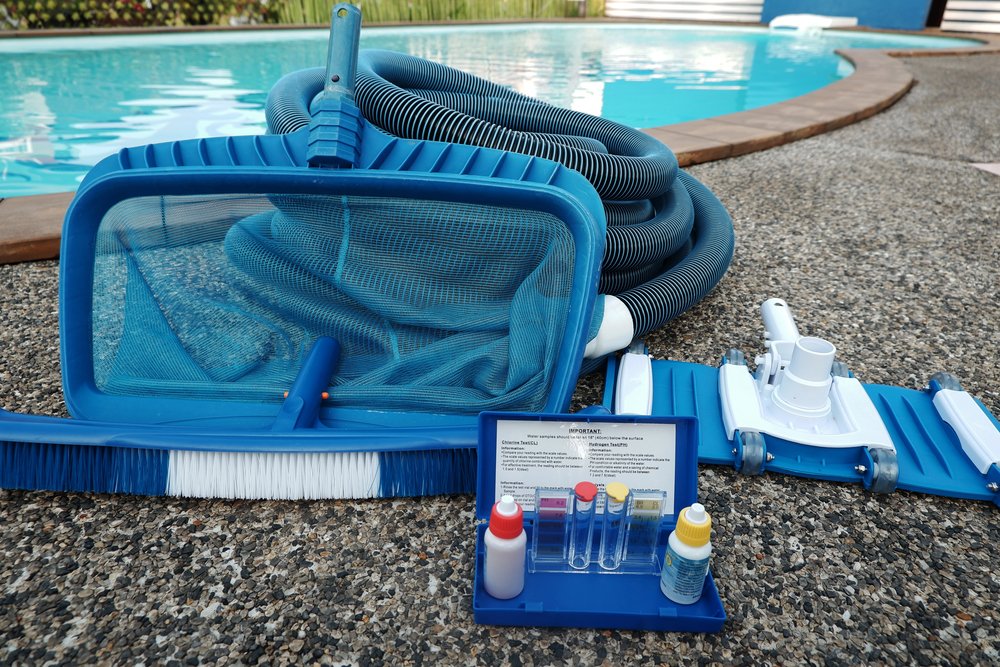
Chemical costs typically run $20–$100 a month depending on pool material and system — fiberglass pools trend toward the low end (~$175/year total), vinyl in the middle (~$400/year), and concrete toward the high end (~$750/year). Beyond sanitizer, most owners are also buying pH balancers, stabilizer, algaecide, clarifier, and stain preventer over the course of a season. Testing 2–3 times a week is the standard recommendation, since catching an imbalance early is far cheaper than fixing algae growth or equipment damage after the fact.
Electricity for Pump and Equipment
The pump is usually the single biggest line item, and pump type changes the number dramatically: a single-speed pump typically draws 1,800–2,500 watts and runs about $50/month, while a variable-speed pump sips 50–500 watts and runs closer to $13/month for equivalent filtration — a 50–80% cut in energy use. Across a full season, a pump alone typically uses 3,000–5,000 kWh, or roughly $480–$800/year at average electricity rates. Most owners see their electric bill jump 30–50% during swim season from pump and (if applicable) heater draw alone.
Professional Service vs. DIY
Weekly professional pool service typically runs $80–$150/month, versus roughly $45/month in chemicals and supplies for DIY care — a gap of around $1,200 a year. That said, professional service isn’t purely a convenience cost: technicians tend to catch small problems (a failing pump seal, an early-stage leak) before they become expensive ones, and DIY care has a genuine learning curve. Many owners land on a hybrid: handling daily skimming and testing themselves, and scheduling a professional for periodic deep cleans or equipment checks.
Seasonal Costs to Plan Around
Spring Opening
Opening averages around $300, typically $200–$400 depending on pool type and size — inground pools run $250–$400, above-ground $150–$250. A professional opening covers cover removal, interior cleaning, reconnecting and inspecting equipment, and an initial chemical balance; any equipment that failed to survive winter storage often surfaces here as an added cost.
Summer Peak
Summer is the highest-cost season across the board: chlorine breaks down faster in strong sun, more swimmers mean more contaminants to sanitize, and pumps run longer hours. Expect chemical costs toward the top of their range, an electricity bump of $30–$150/month from longer pump and filtration runtime, and it’s worth setting aside $200–$500 for the repairs that tend to surface during heavy summer use.
Fall Closing and Winterization
Closing service runs $250–$500 for inground pools and $150–$300 for above-ground. A proper winterization lowers the water level, balances chemistry for dormancy, blows out and adds antifreeze to the plumbing, and gets a cover installed — skipping any of these steps risks a costly freeze crack that far exceeds what proper closing would have cost. Covers themselves range widely: basic winter covers run $75–$250, while premium safety covers run $1,000–$3,600.

Costs That Catch New Owners Off Guard
Insurance Premium Increases
A pool is treated by most insurers as an added liability risk, which typically raises homeowners premiums by $20–$25/month. Insurers often also require raising liability coverage (commonly from $100,000 to $500,000), adding roughly $50–$75/year, and some owners add an umbrella policy (around $200–$300/year for $1 million in coverage) for extra protection. Note too that many insurers require specific safety features to keep coverage valid at all.
Repairs and Part Replacements
Even well-maintained pools eventually need repairs. Typical ranges: pump replacement $700–$3,000, filter repair or replacement $800–$2,000, heater repair $400–$700 (full replacement $5,000+), leak detection $100–$500, and structural crack repair around $75 per linear foot. Leaks tend to be the costliest single issue, with inground pool leak repairs commonly running $350–$2,700 before accounting for the water lost.
Water Usage and Refills
Evaporation and splash-out mean regular top-offs, especially in hot or windy conditions, and most pools need a full drain-and-refill every five to seven years — a noticeable one-time spike in the water bill. Across a season, expect utility costs from water alone to add roughly $40–$50/month.
Safety Feature Requirements
Local codes commonly require a barrier at least 4 feet high, self-closing and self-latching gates, door alarms on house entrances to the pool area, and properly fitted drain covers. Quality safety covers run $1,000–$3,600, and underwater alarms with motion sensors run $150–$220 — costs worth budgeting for up front rather than treating as optional, since skipping them can also void insurance coverage.
The 5–10 Year Outlook
Major Equipment Replacement
Pool equipment typically lasts 10–20 years with good maintenance, but individual components wear out on their own timelines: pumps 8–12 years, filters 5–15 years, heaters 7–10 years, and automation systems 5–8 years. Replacing everything at once — equipment, labor, and installation — typically runs $7,345 to $28,925, which is why many owners spread replacements out and use off-season timing to save on labor.
Resurfacing
Most pool surfaces need resurfacing every 10–20 years, running roughly $5,000 per 1,000 square feet depending on finish type. Waiting too long tends to cost more: removing failed coating before restoring the surface can add over 50% to the job compared to resurfacing before it fully deteriorates.
Technology Upgrades
Smart pumps and automated chemical monitoring can cut energy use by 50–80% by adjusting flow and dosing based on real conditions rather than a fixed schedule. Parts for older equipment also get harder and pricier to source as manufacturers move on to newer models, which pushes some owners toward upgrading sooner than they’d planned.
Frequently Asked Questions
What’s a realistic annual budget for pool ownership?
Basic maintenance alone runs $960–$1,800/year. Once repairs, seasonal service, water, and incidental costs are included, most owners land between $1,400 and $5,995/year depending on pool size, climate, and how much is DIY versus professional.
Is a variable-speed pump worth the extra upfront cost?
For most owners, yes — the 50–80% cut in electricity use compared to a single-speed pump typically pays back the price difference within a few years, and it keeps paying off for the life of the pump after that.
How much should I keep in reserve for pool repairs?
A commonly cited planning range is $400–$1,000/year for typical repairs, on top of routine maintenance — with the understanding that a major failure (a heater or pump replacement) can exceed that in a single year.
Does a saltwater system actually save money?
Usually, yes, on an ongoing basis — you’re not buying chlorine regularly — but it comes with its own periodic cost (a salt cell typically needs replacing every 3–7 years). Most owners find the math favors saltwater over a multi-year horizon even after that expense.