Testing your pool water is only half the job — knowing exactly how much chlorine, pH adjuster, or alkalinity increaser to add is what actually gets your water back in balance. Enter your pool’s volume and current readings below to get an exact dose.
Pool Chemical & Chlorine Dosage Calculator
Find out how much chlorine, pH adjuster, or alkalinity increaser to add.
Don't know your gallons? Use our Pool Volume Calculator first.
Typical target: 3 ppm for regular maintenance, 10 ppm for shocking a green or cloudy pool.
Ideal range is 7.2–7.6.
Ideal range is 80–120 ppm.
Chlorine —
Add
Target is at or below current level — no chlorine needed.
Raises free chlorine by ppm.
pH Adjustment
Add
pH is already at target — no adjustment needed.
Total Alkalinity Adjustment
Add Baking Soda
TA is already at or above target — no increase needed.
Need to restock?
Shop liquid chlorine, cal-hypo, pH and alkalinity balancers, and test kits on Amazon.
Shop Pool Chemicals on Amazon →Want a full monthly cost picture? Check out our Pool Cleaning Cost guide.
How Pool Chemical Dosing Works
Pool chemical dosing comes down to one core idea: the amount of chemical you need depends on both your pool’s water volume and how far your current reading is from your target. A small above-ground pool needs a fraction of what a large inground pool needs to make the same change, which is why every dosing chart starts with gallons.
Free Chlorine (Sanitizer Level)
Free chlorine (FC) is what actually kills bacteria and algae in your pool. For routine maintenance, most pools are kept between 2–4 ppm. If your pool has turned green, cloudy, or has an algae bloom, you’ll typically shock it up to 10 ppm or higher (following CYA-based shock guidelines from the CDC or your test kit).
The calculator above uses the standard water-treatment dosing formula — ppm change × (gallons ÷ 1,000,000) × 8.34 — to find the pounds of active chlorine needed, then divides by your product’s percent-available chlorine to get an actual amount of liquid or granular product to add.
pH
Pool water pH should sit between 7.2 and 7.6. Below that range, water becomes corrosive to metal fittings and heaters and can irritate skin and eyes; above it, chlorine becomes far less effective at sanitizing. Soda ash (sodium carbonate) raises pH, while muriatic acid or dry acid lowers it.
Total Alkalinity
Total alkalinity (TA) acts as a buffer that keeps pH from swinging wildly every time you add chlorine or the pool gets rained on. The ideal range is 80–120 ppm. Baking soda (sodium bicarbonate) is the standard, inexpensive way to raise it.
Order of Operations
- Total Alkalinity first — it stabilizes pH so your next adjustments actually hold.
- pH second — correct pH before shocking, since chlorine works best in the right range.
- Chlorine last — sanitize once your water chemistry is balanced.
Always add chemicals separately, never mix them together before adding to the pool, and retest after a few hours of circulation before dosing again.
Why Pool Chemistry Matters More Than You Think
Pool chemistry problems send more than 4,500 people to emergency rooms yearly in the US. The right chemical balance in your pool matters more than just keeping the water clear — it’s crucial for everyone’s safety.
Pool chemistry revolves around several key measurements that work together. Your pool’s pH level should stay between 7.4 and 7.6, though readings from 7.2 to 8.0 remain acceptable. On top of that, it takes proper alkalinity (100-150 ppm) to keep pH levels stable. The chlorine should stay between 1.0 to 3.0 parts per million. Saltwater pools need different attention, especially when you have specific equipment and salt level requirements.
Pool chemistry does more than keep your water clear – it protects your health and investment. Pool owners often don’t realize how chemical imbalances can quickly turn from small issues into major problems.
Health risks of unbalanced water
Bad chemical balance creates perfect conditions for harmful bacteria. Health experts say waterborne pathogens can cause stomach illnesses that are especially dangerous for children, seniors, and people with weak immune systems. Your pool water can also cause physical discomfort. Too much chlorine hurts skin, eyes, and lungs. That classic “pool smell” comes from chloramines – spent chlorine compounds – not from excess chlorine as many people think.
Your pool’s pH level plays a huge role in swimmer comfort. Human eyes naturally stay at pH 7.0, so water with different levels causes stinging. Acidic water stings eyes and nasal passages. It also makes skin and hair dry and itchy. High pH levels can cause skin rashes, red irritated eyes, and damage swimsuits faster.
Equipment damage from poor chemistry
Bad pool chemistry quietly damages your equipment. Water that’s too acidic or alkaline doesn’t just hurt swimmers – it slowly destroys your investment. Acidic water below pH 7.2 corrodes metal parts like ladders, railings, lights, pumps, filters, and heaters. This corrosion eventually causes leaks, valve problems, and expensive equipment failures.
Scale buildup creates another big challenge. High calcium hardness or pH levels make minerals settle out of the water and form scale throughout your system. Scale causes serious problems on heat exchangers. It creates an insulating layer that reduces heating efficiency, uses more energy, and makes your equipment work harder. This extra strain causes short cycling where equipment turns on and off quickly, which speeds up wear and tear.
The cost hits hard – fixing or replacing equipment damaged by chemical problems often runs into thousands of dollars.
Visual cues of imbalanced water
Your pool shows chemical problems through clear signs:
- Cloudy or hazy water shows filtration problems or chemical imbalance – usually the first warning something’s wrong
- Slippery or slimy surfaces point to low chlorine levels and algae growth
- Strong “chlorine” smell actually means you need more free chlorine because chloramines have built up
- Unusual coloration (green, yellow, brown) indicates metals, algae, or poor sanitizer levels
- White, crusty buildup on tiles or corroded fixtures shows calcium hardness or pH problems
These visible signs aren’t just cosmetic issues – they warn you about developing problems. These problems become harder and more expensive to fix if ignored. Regular testing helps catch these issues early, before you need professional help.
Good pool chemistry isn’t just about comfortable swimming – it’s crucial maintenance that protects your health, equipment, and investment in your pool.
How to Test and Monitor Pool Water
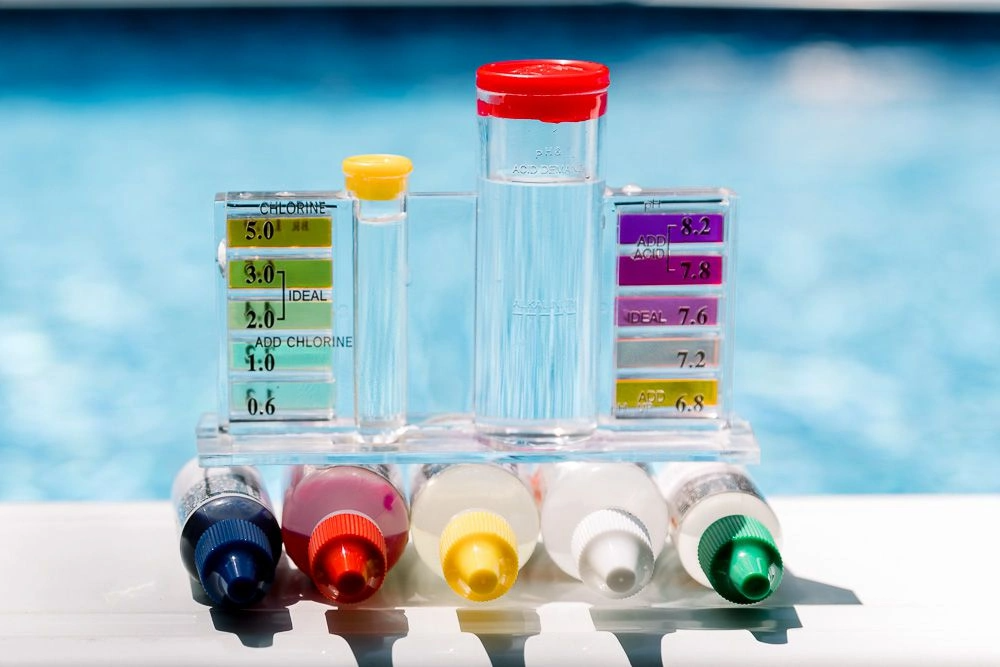
Testing your pool water regularly is the life-blood of good maintenance. You can catch small chemical imbalances early through regular monitoring before they turn into major problems that harm swimmer health and pool equipment.
Daily, weekly, and monthly testing routines
A consistent testing schedule will give a balanced swimming pool chemistry throughout the swimming season. Here’s the testing frequency recommended for most residential pools:
- 2-3 times weekly: pH and Free Chlorine (FC) levels
- Weekly: Total Alkalinity (TA)
- Monthly: Calcium Hardness (CH), Cyanuric Acid (CYA), and Total Dissolved Solids (TDS)
You’ll just need more frequent testing in certain situations. Test at least twice weekly during peak summer months when temperatures rise above 70°F, and bump it up to daily testing when temperatures soar or pool usage increases. Always retest your water after heavy rainstorms since they dilute chemicals and bring in contaminants. Salt levels should be checked at least monthly for saltwater pool owners, and more often during heavy rain periods.
Evening is the best time to collect water samples after the water has moved around all day. Get samples from elbow-depth (12-18 inches below the surface), and stay away from return jets and chemical dispensers. This approach will give a true picture of your pool’s current chemical state.
Using FAS-DPD vs. OTO test kits
Your choice of test kit affects your water testing accuracy by a lot. Three main methods exist to test chlorine levels:
OTO (orthotolidine) tests give the fastest results—you can see them in about 20 seconds—but they only measure total chlorine without showing the difference between free and combined forms. These tests work for quick checks but lack the precision you’ll want for detailed maintenance.
Standard DPD tests are better than OTO because they show the difference between free and combined chlorine. But they still depend on color matching, which gets tricky in different light conditions or for people who have trouble seeing colors.
FAS-DPD (ferrous ammonium sulfate) tests are the gold standard for pool testing. This titration method shows a clear endpoint when the sample changes from pink to colorless, instead of subjective color matching. It measures chlorine levels from as low as 0.2 ppm up to 20 ppm, making it perfect for routine testing and fixing high chlorine problems.
Pool professionals usually pick detailed test kits that have FAS-DPD testing for chlorine plus tests for pH, alkalinity, hardness, and cyanuric acid. These kits give you everything you need to know for proper pool care.
How to calculate Combined Chlorine (CC)
Combined chlorine (chloramines) forms when free chlorine mixes with contaminants like sweat, urine, and body oils. These compounds irritate eyes, cause skin problems, and create that familiar “chlorine smell” that actually shows too little—not too much—chlorine.
Here’s how to calculate combined chlorine levels:
- Test for Free Chlorine (FC) using your test kit
- Test for Total Chlorine (TC)
- Subtract FC from TC to determine CC: Combined Chlorine = Total Chlorine – Free Chlorine
Combined chlorine should stay below 0.5 ppm. You’ll need shock treatment when levels go above 0.2 ppm (the industry standard maximum). Add about 10 times the measured CC amount in free chlorine to break down these compounds. This breakpoint chlorination process gets rid of irritating chloramines and brings back proper sanitizing power.
Test reagents last about a year. Keep them in cool, dry places away from sunlight to stay accurate. A well-maintained test kit will keep your swimming pool chemistry balanced and protect both swimmers and equipment.
Managing Alkalinity, Hardness, and Stabilizer
The right chemical levels are essential to keep your pool water safe and balanced. Pool tests show when levels are off, and quick action prevents damage to both your equipment and swimmers.
Raising and lowering pH with acid or soda ash
pH levels affect almost every aspect of water chemistry, so adjustments need precision. Sodium carbonate (soda ash) works best to raise pH above 7.2, better than baking soda when you only need pH adjustment. A 10,000-gallon pool with low pH needs 3-4 pounds of soda ash to bring levels back to normal.
Sodium bisulfate (dry acid) or muriatic acid fixes high pH (above 7.8). Dry acid is safer to handle and store, while muriatic acid acts faster but needs extra safety measures. Vinyl, fiberglass, or painted pools need dry acid to avoid surface damage.
Managing alkalinity with baking soda or acid
Your pH buffer comes from total alkalinity — you should keep it between 110-150 ppm. Sodium bicarbonate (baking soda) raises alkalinity without much effect on pH. Add 1.5 pounds of baking soda per 10,000 gallons to raise alkalinity by about 10 ppm.
Muriatic acid reduces alkalinity well, but technique matters. The quickest way to lower alkalinity with minimal pH change is to add acid in one spot with the pump off — this means “pooling” instead of “walking” it around.
Calcium increasers and dilution for hardness control
The ideal calcium hardness range sits between 200-400 ppm. Calcium chloride increases levels — 1.25 pounds per 10,000 gallons adds 10 ppm. Broadcast calcium chloride directly across the surface with the pump running. It creates heat when mixed with water, so never pre-dissolve it in buckets.
A partial water change works best to reduce high calcium levels. Replacing one foot of water usually does the trick. This method works because tap water has about 120 ppm calcium.
CYA adjustment using stabilizer or water replacement
Cyanuric acid (CYA) shields chlorine from UV rays and should stay between 30-100 ppm. Commercial stabilizer or conditioner raises CYA — 13 ounces adds 10 ppm in a 10,000-gallon pool.
CYA builds up over time since it breaks down slowly. Partial drainage and dilution are the only ways to reduce high CYA. You can drain and refill one foot at a time to gradually lower levels.
Let chemicals work for 6-24 hours before testing again and making more adjustments. Add each chemical separately and give them time to circulate between additions.
Saltwater Pool Chemistry vs. Traditional Pools
Saltwater pools offer a popular alternative to traditional chlorine pools. Many people misunderstand how these systems actually work.
How salt chlorine generators work
Salt chlorine generators don’t fill pools with seawater – they create chlorine through electrolysis. The process starts when salt water flows through an electric current in the cell. This breaks down sodium chloride (NaCl) into chlorine gas that sanitizes the water. The system creates hypochlorous acid and sodium hypochlorite, which are the same sanitizing agents found in traditional chlorine pools. The chlorine reverts back to salt after completing its sanitizing work, which creates a continuous cycle.
Ideal salt levels: 3,000–3,500 ppm
Salt concentrations should stay between 2,700-3,400 ppm, with 3,200 ppm as the sweet spot. This range gives a perfect balance of chlorine production and comfortable swimming conditions. Most systems display warnings when salt levels drop below 2,600 ppm and shut down at 2,400 ppm. High concentrations above 3,500 ppm can make equipment overheat or stop working. The recommended pool water contains just one-tenth of ocean water’s salt concentration.
Salt and fiberglass compatibility
Fiberglass pools work best with salt systems. Their non-porous gel coat finish fights off salt-related corrosion and chemical buildup. Concrete pools face different challenges – their surfaces can deteriorate, especially those with plaster finishes. Vinyl-liner pools that have steel walls might suffer from galvanic corrosion if the liner gets damaged.
Saltwater pros and cons by pool type
Benefits for all pool types:
- Water feels softer with less irritation to skin and eyes
- Chemical odors decrease and maintenance becomes easier
- Water chemistry stays more stable with fewer pH swings
Considerations by material:
- Fiberglass: Pairs perfectly with salt and needs minimal maintenance
- Concrete: Watch out for surface erosion, particularly with plaster finishes
- Vinyl: Metal parts could get damaged if liner fails
Saltwater systems have clear advantages but need an upfront investment of $800-2,000. You’ll also need to replace the cell every 3-7 years at $700-900.
Preventive Maintenance and Automation Tips
Automated pool maintenance saves time and keeps your swimming pool chemistry consistent without manual intervention.
Using automatic chlorinators and pH controllers
Automatic chlorinators add measured chlorine amounts into your return water to maintain levels between 1-3 ppm. These systems work effectively with slow-dissolving trichlor tablets that dissolve during pump operation. The best approach is to start with lower settings and adjust based on test results. Systems like IntelliPH handle pH control by dispensing acid to reduce fluctuations. CO2 infusion serves as an acid-free alternative to lower pH levels.
Filter cleaning and backwashing schedules
Your filters need cleaning once pressure increases 8-10 PSI above normal baseline. Sand filters need backwashing every 2-4 weeks, while DE filters require it every 4-6 weeks. The proper backwash process involves turning off power, setting the valve to “backwash,” restarting, running for two minutes, and rinsing for 60 seconds before returning to filter mode.
Skimming, brushing, and vacuuming best practices
Daily skimming stops debris from sinking and overloading your filter. Your pool’s walls need brushing twice weekly to prevent algae growth. You’ll need to vacuum once debris sinks beyond the skimmer’s reach. Robotic pool cleaners clean walls and floors automatically.
Professional help timing
Pool professionals should handle persistent algae outbreaks, equipment malfunctions, and heavy post-storm debris. Professional service costs range from $75-150 per visit. You should also call experts if the chlorine smell becomes too strong.
Frequently Asked Questions
How often should I test my pool water?
2–3 times per week during swim season, and daily during a heat wave, heavy rain, or heavy bather load.
Can I use this calculator for a hot tub or spa?
The same formulas apply, but hot tubs are small enough that even tiny dosing errors swing ppm readings fast — add half the suggested amount, retest, and adjust from there.
Why did my chlorine reading not change after dosing?
High chlorine demand (from algae, combined chlorine, or low stabilizer/CYA) can consume added chlorine before it registers on a test strip. Retest in a few hours, and consider a CYA test if this keeps happening.
Conclusion
Pool owners who manage to keep proper swimming pool chemistry get safer and more enjoyable swimming experiences. Balanced chemicals protect swimmers’ health and pool equipment alike, and water testing is crucial to effective pool care — serious pool owners should use FAS-DPD test kits because they give the most accurate results.
Each chemical plays a unique role in your pool’s health. The pH level affects how comfortable the water feels and how long your equipment lasts. Your pool’s alkalinity keeps pH levels stable. Calcium hardness stops surface damage, while cyanuric acid protects chlorine from UV breakdown. These elements don’t work alone – they form a complete system.
Saltwater pools are popular because they generate chlorine continuously, though you’ll still need to monitor and maintain them despite what many people think. They work especially well with fiberglass pools but might cause issues with concrete surfaces over time.
Automated systems can reduce your maintenance work by a lot, but you’ll still need to understand simple pool chemistry principles. Whatever automation you have, you need to skim, brush, and maintain filters regularly.
Understanding pool chemistry lets you control your pool’s condition instead of fixing problems later. Good testing methods and knowledge of chemical interactions help you keep your water crystal clear and comfortable, your equipment lasts longer and costs less to maintain, and a pool in good condition gives your family and friends years of fun, exercise, and relaxation.