Knowing how many gallons of water are in your pool is essential for dosing chemicals correctly, sizing a heater or pump, and budgeting a refill. Pick your pool’s shape below, enter a couple of measurements in feet, and get an instant volume — in gallons, liters, and cubic feet.
Pool Volume Calculator
Find out how many gallons are in your pool.
Measure the longest and shortest points straight across the pool.
Enter the diameter — the distance straight across the widest point.
Pool Volume
Use this number to dose chemicals correctly and budget refills. Curious what upkeep costs? See our Pool Cleaning Cost guide.
Estimate only — irregular or kidney-shaped pools are best measured by breaking the shape into smaller rectangular or circular sections and adding the results together.
Have an irregular or kidney-shaped pool? Mentally break it into smaller rectangular or circular sections, run each one through the calculator above, and add the results together.
How to Calculate the Volume of Water in Your Swimming Pool
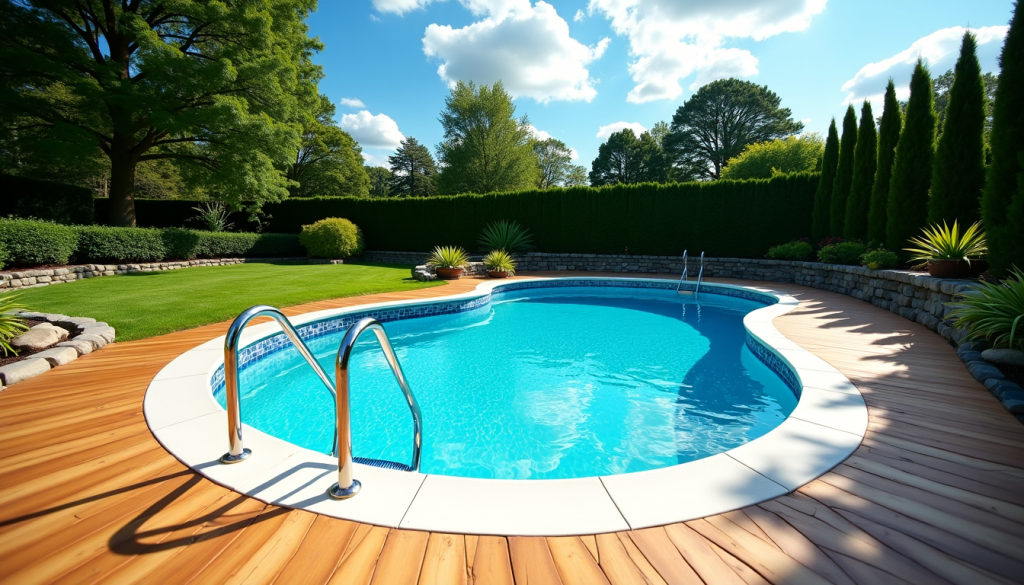
Knowing the volume of water in your swimming pool is essential for proper maintenance, chemical balancing, and cost estimation for water refills. Whether you’re topping off your pool or planning a complete fill, calculating the volume is straightforward with a little math and some measurements.
Step 1: Gather Your Tools
Before you start, make sure you have:
- A measuring tape or ruler
- A calculator (optional but helpful)
Step 2: Measure Your Pool
Pools come in various shapes, and the formula for calculating volume will depend on the shape of your pool. Below are common pool shapes and their volume calculation methods:
Rectangular or Square Pools
- Measure Dimensions: Measure the length, width, and average depth of the pool in feet.
- Calculate Volume: Use the formula:Volume (in cubic feet) = Length × Width × Average DepthConvert cubic feet to gallons by multiplying by 7.48:Volume (in gallons) = Volume (in cubic feet) × 7.48
Circular Pools
- Measure Dimensions: Measure the diameter and average depth.
- Calculate Volume: Use the formula:Volume (in cubic feet) = π × (Radius^2) × Average DepthNote: Radius is half the diameter, and π (pi) is approximately 3.14.Convert to gallons:Volume (in gallons) = Volume (in cubic feet) × 7.48
Oval Pools
- Measure Dimensions: Measure the longest diameter (length), the shortest diameter (width), and the average depth.
- Calculate Volume: Use the formula:Volume (in cubic feet) = π × (Length/2) × (Width/2) × Average DepthConvert to gallons:Volume (in gallons) = Volume (in cubic feet) × 7.48
Irregular or Kidney-Shaped Pools
- Break Into Shapes: Divide the pool into simpler geometric shapes, such as rectangles, circles, or triangles.
- Calculate Individually: Find the volume of each section using the appropriate formula.
- Sum the Volumes: Add them together for the total volume.
Step 3: Adjust for Slopes or Depth Variations
If your pool has a shallow end and a deep end, calculate the average depth:
Average Depth = (Shallow Depth + Deep Depth) / 2
Use this average depth in your calculations for more accurate results.
Step 4: Verify and Record
After calculating the volume, consider rounding the number slightly for easier reference. Keep this number handy for future pool maintenance.
Example Calculation
Imagine you have a rectangular pool that’s 20 feet long, 10 feet wide, with a shallow end of 3 feet and a deep end of 7 feet. Here’s how to calculate:
- Average Depth = (3 + 7) / 2 = 5 feet
- Volume (cubic feet) = 20 × 10 × 5 = 1,000 cubic feet
- Volume (gallons) = 1,000 × 7.48 = 7,480 gallons
Wrapping Up
Calculating your pool’s volume is a vital step in pool ownership that ensures optimal maintenance and enjoyment. By taking the time to measure and compute accurately, you’ll have all the information you need to keep your pool in perfect condition. Happy swimming!